Seeing and Believing: Microscopy and the early Royal Society
Seeing and Believing: Microscopy and the Early Royal Society
Key Stage 4 & Key Stage 5 | Museum based
Session details
Delivery
Museum based
Curriculum Links
Philosophy of science,
History of ideas
Key Stage 4 & Key Stage 5
Suitable for Years 10 & 11 and Years 12 & 13 (post-16)
Length of session
75-90 minutes
Maximum group size
20 students
In this session students will:
Explore early scientific instruments
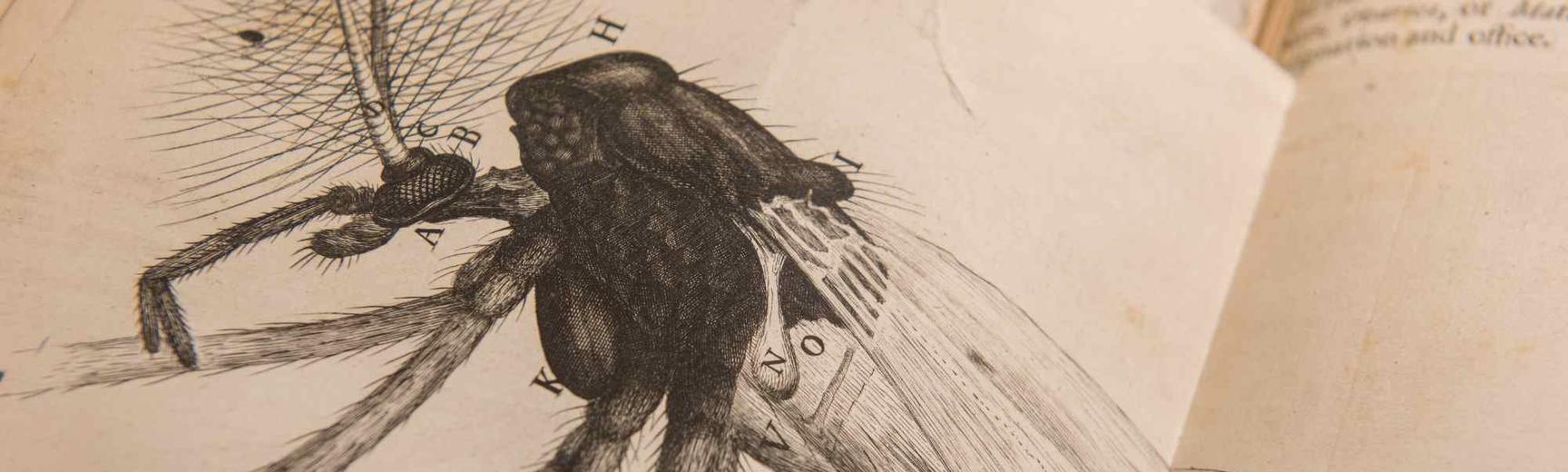
See Robert Hooke’s amazing book Micrographia (1665)
Explore ideas about scientific observation using modern microscopes
The Museum has a fine collection of optical instruments including early microscopes.
In this session we will look at the invention of the microscope in the 1600s CE, and how it opened up a whole new world of observations.
We will look at an original edition of Robert Hooke’s famous book Micrographia (1665) which includes amazing illustrations of what was until then an invisible world which inspired a sense of wonder.
We will learn about Hooke’s role in the early Royal Society — England’s first professional scientific institution — and how microscopy became a focus for the Society’s mission to champion the new method of science based on empirical observations.
As well as seeing original instruments, they will use modern microscopes to investigate and explore ideas about scientific observation.
This session offers particular insights into how science works.
To view artwork created using microscopes and lenses in public events, see the online Making Micrographia gallery.